
How Bench Warrants Work in Virginia
Most people say "bench warrant" when a court orders someone brought in after a missed appearance or a broken order. Virginia paperwork often uses other titles. A docket entry might name a capias, an attachment, a summons, or a show-cause order instead. The issuing court's record and its current order control. A missed date alone won't tell you which instrument issued or whether it still stands. The reasons vary. A Virginia bench-warrant question can grow from a skipped criminal hearing, a release condition, money owed after judgment, or a family or support matter. Those paths are not the same. Someone in Virginia who missed a hearing before trial may face different process than a person with an unpaid balance after conviction. A JDR matter can carry tighter privacy limits too. So start with the case. Ask the Virginia clerk which event and order are at issue. Then confirm service with the responsible local agency. That local check is how a Virginia resident gets a straight answer.
Virginia Bench Warrant Terms: Capias
"Bench warrant" isn't a universal label in Virginia. Titles matter here. The district-court form DC-361 is titled "Capias – Attachment of the Body." A capias directs that a person be brought before a court. Don't relabel it as a capias pro fine. Neither term covers every failure to appear, either. A show-cause order just asks a person to answer an alleged violation, and it is not automatically an arrest warrant. The Virginia clerk can identify the actual paper and explain the docket entry.
- FTA
- Failure to appear at a required court date. The legal result depends on the case, notice, conduct, and court order.
- Capias
- Court process directing that a person be brought before the court; its purpose depends on the specific instrument.
- Recall
- A request for the issuing court to withdraw process or reset the case. The judge or court record must establish the result.
- Bond forfeiture
- A possible loss of security after a willful missed appearance, subject to notice, good cause, and the court’s decision.
The official Virginia criminal-forms index lists district-court forms by name and number. It shows form titles, not a completed case form. Personal fields stay private. A reader can learn the exact terms a Virginia court uses.
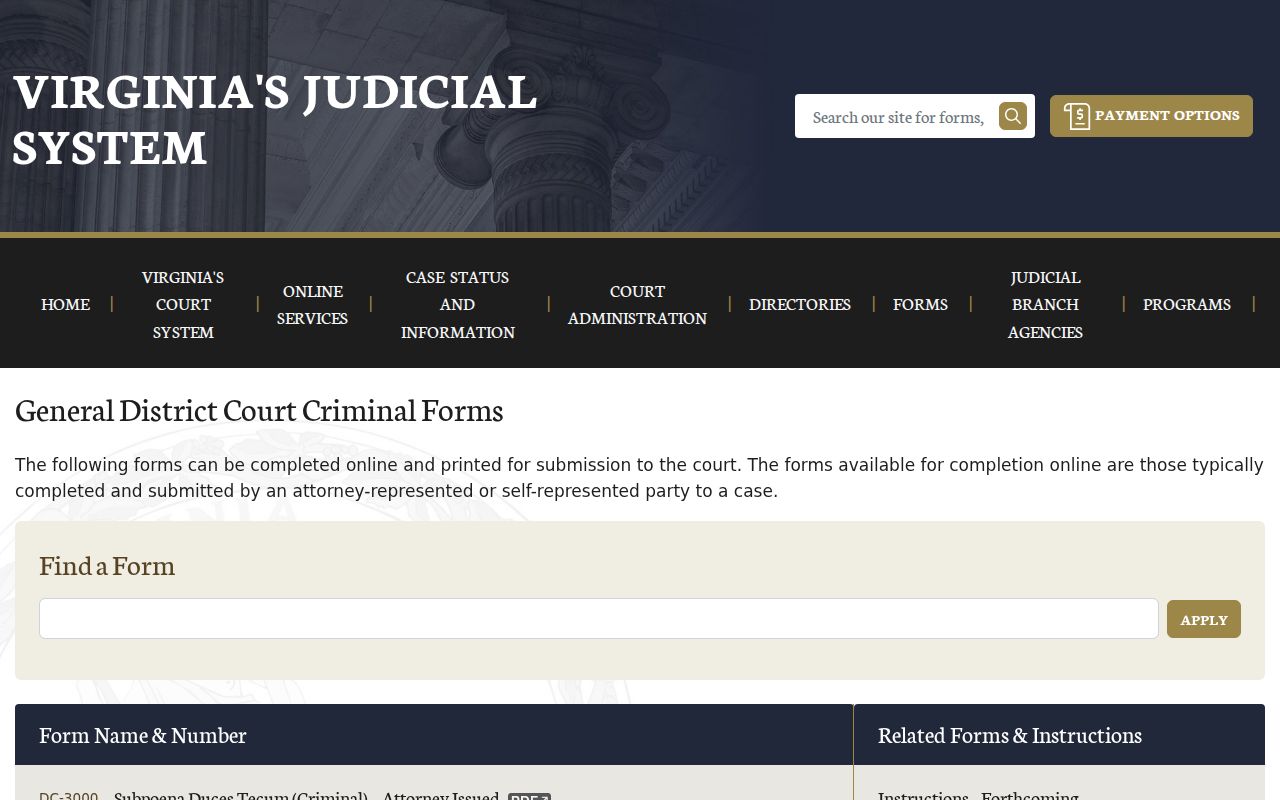
For a specific capias or attachment in Virginia, match the official form title to the court's order. Don't trust a generic online label.
Bench Warrant Issuance in Virginia
It depends on the underlying proceeding. Virginia's failure-to-appear statute covers people released on bail or summoned under criminal procedure who willfully stay away. The court can address security and issue more process. A missed date can also mean a show-cause proceeding, a release violation, or a post-judgment payment matter. "Bench" doesn't prove a judge signed the form. It doesn't reveal the authority used either. Entry, service, and database listings are separate steps. Once process issues, the Virginia court files it, law enforcement serves it, and a restricted database may log it. The public docket in Virginia shows a hearing or limited service information. It won't show everything the sheriff or police hold. Virginia State Police runs VCIN. That network connects authorized agencies, and the public cannot query VCIN or NCIC. An order stays live until the court changes it or another legal event resolves it. A Virginia status page is not a recall. For the criminal failure-to-appear rule, read the current Code of Virginia § 19.2-128. The clerk can confirm which hearing was missed. The clerk can also say whether the Virginia court issued a capias, warrant, summons, or other process.
Virginia FTA Rules for Bench Warrants
Virginia law does not treat every missed appearance as flight. The 2026 version of § 19.2-128 draws the line. It defines “willfully fails to appear” as intentional conduct meant to avoid judicial process. One earlier nonappearance alone proves nothing, though a pattern of recurrent, purposeful evasion may be considered. When willfulness is at issue, the court must weigh the mitigating circumstances the statute lists. Those include an unforeseen illness or injury, transportation problems, inability to obtain dependent care, and affirmative steps to communicate about or remedy the missed date. The rule matters for bond forfeiture. It also matters for the separate criminal penalties that can attach in qualifying felony or misdemeanor cases in Virginia. It does not erase the missed hearing. Nor does it guarantee a recall. It does not stop the court from issuing appropriate process, either. If illness, a transit breakdown, or a care emergency caused the absence, preserve the records that show it. Tell the court promptly. A Virginia lawyer can present that information and ask which local filing or appearance procedure applies. The willfulness test is a legal standard for the judge. It is not a public status code anyone can read out of a name search in Virginia. Ask the issuing clerk which order appears on the docket, and whether the court has set a hearing or expects a motion before it acts.
How Bench and Arrest Warrants Differ
A Virginia bench warrant ties back to an existing court obligation, such as a missed required appearance. An arrest warrant starts somewhere else. It begins with a criminal allegation and a probable-cause determination by an authorized judicial officer. That difference shapes your first question. A bench-warrant question starts with the court file and the missed event. An arrest-warrant question starts with the sworn complaint and the charge. Virginia case records do not always use consistent labels. Confirm the instrument with the clerk before you rely on it. Either form can authorize an arrest. Both may be handled by local law enforcement. A public court search in Virginia may show the underlying case while omitting restricted law-enforcement status. For more on probable-cause issuance, see Arrest Warrant Lookup.
| Feature | Bench Warrant | Arrest Warrant |
|---|---|---|
| Typical starting point | A missed appearance, release condition, or other court obligation | A criminal complaint and a probable-cause finding |
| Process language | May be called a capias, attachment, or other court process | Usually identified as an arrest warrant in the process record |
| First record to confirm | The existing case docket and the order tied to the missed event | The criminal case, issuing authority, and alleged offense |
| Who can change status | The issuing court; the serving agency updates its record | The issuing court or authorized judicial officer; the agency updates its record |
What to Ask After Missing Virginia Court
Start with the paperwork. A citation, summons, or case paper from a missed Virginia GDC hearing identifies the locality and the case number. Take that to the official OCIS 2.0 portal, which offers name, case-number, and hearing-date searches for covered cases. Virginia provides no public statewide warrant lookup. A result can identify the court and docket. A no-result does not prove there is no warrant. The legacy GDC case-search help adds a wrinkle: a user selects one court at a time. So call the clerk of the Virginia court that owns the case. Ask what process followed the missed hearing, whether it is still active, and how to request a new hearing or recall. Next, contact the local sheriff or police unit responsible for service. The issuing agency and the serving agency may differ. Ask which office holds the process before you travel. The clerk explains the court file. The law-enforcement office explains service status. It can also explain local appearance or booking steps. If illness, transport trouble, or a dependent-care problem caused the miss, say so promptly. Then ask how the court accepts supporting information. Virginia cases can sit in a county or an independent city far from where you live, so use the locality links in Browse Counties to pin down the one tied to your case. Do not assume the nearest Virginia courthouse owns it.
Requesting Virginia Warrant Records
A formal records request asks a Virginia public body for a record it already holds. It cannot force an agency to create a statewide warrant report or reveal restricted VCIN/NCIC information. Under the Virginia Freedom of Information Act, describe the record with reasonable specificity. A public body generally responds within five working days. That response may be a production, a lawful withholding, a notice that records are not found, or an allowed extension. Actual-cost charges may apply. Take court-file questions to the clerk that owns the case. Ask Virginia police or the sheriff for records they hold. Check their public pages for any local warrant-list scope notice. Virginia State Police publishes its FOIA request methods for records in VSP custody. Its Wanted Persons program is a selected tip channel, not a personal warrant check. A VSP request cannot query restricted criminal-information databases. It cannot certify that local Virginia process was recalled either. The court and the responsible service agency remain the sources for that case status.
Clearing a Bench Warrant in Virginia
Virginia has no one-click warrant-clearance system. Only the issuing court can recall or quash its process. “Recall” means the court withdraws the warrant. “Quash” means the court sets it aside. Local law enforcement keeps its own execution record. Paying a balance can reduce or satisfy what you owe. That payment does not prove an existing capias was recalled, and a later appearance may still need a court order or a separate service update. So call the clerk before you go to any Virginia courthouse. Ask which process is active, and what documents or motion the court requires.
- Identify the issuing court and case through the citation, public docket, clerk, or counsel.
- Ask the clerk whether the court will set a hearing, accept a motion, or require an appearance.
- Ask the sheriff or police warrant unit how it handles voluntary appearance, bond, and intake; no statewide walk-in promise applies.
- After the court acts, get the disposition or order and confirm the serving agency has updated its record.
Caution: Do not rely on an online result or payment receipt as proof of recall. Confirm the court order and service status before deciding how to appear.
Virginia Bench Warrant Review at Three Years
Virginia has a statutory review process for certain unexecuted criminal process. Under Code of Virginia § 19.2-76.1, the head of the responsible police or sheriff agency files quarterly reports. Those reports cover felony arrest warrants unexecuted for seven years, plus misdemeanor warrants, summonses, capiases, and other process unexecuted for three years. From there, the Commonwealth's Attorney petitions the Circuit Court to destroy the process. The court then orders destruction, subject to exceptions.
Which exceptions? Aggravated-murder warrants survive. So does process a judge agrees to preserve for a justified active investigation. But the calendar itself does no work here. Three or seven years alone never expires a warrant, and a destruction order is the event that matters. Once a court orders destruction, no arrest may be made under that process. So if age is part of a personal case question, ask the clerk whether a petition or destruction order exists on the docket. Then ask the responsible agency whether its own record has caught up with the order.
Separately, Code of Virginia § 19.2-390 requires the destroying agency to clear the related entry from VCIN and NCIC. The review statute turns on a court order, not an automatic countdown attached to every Virginia warrant.
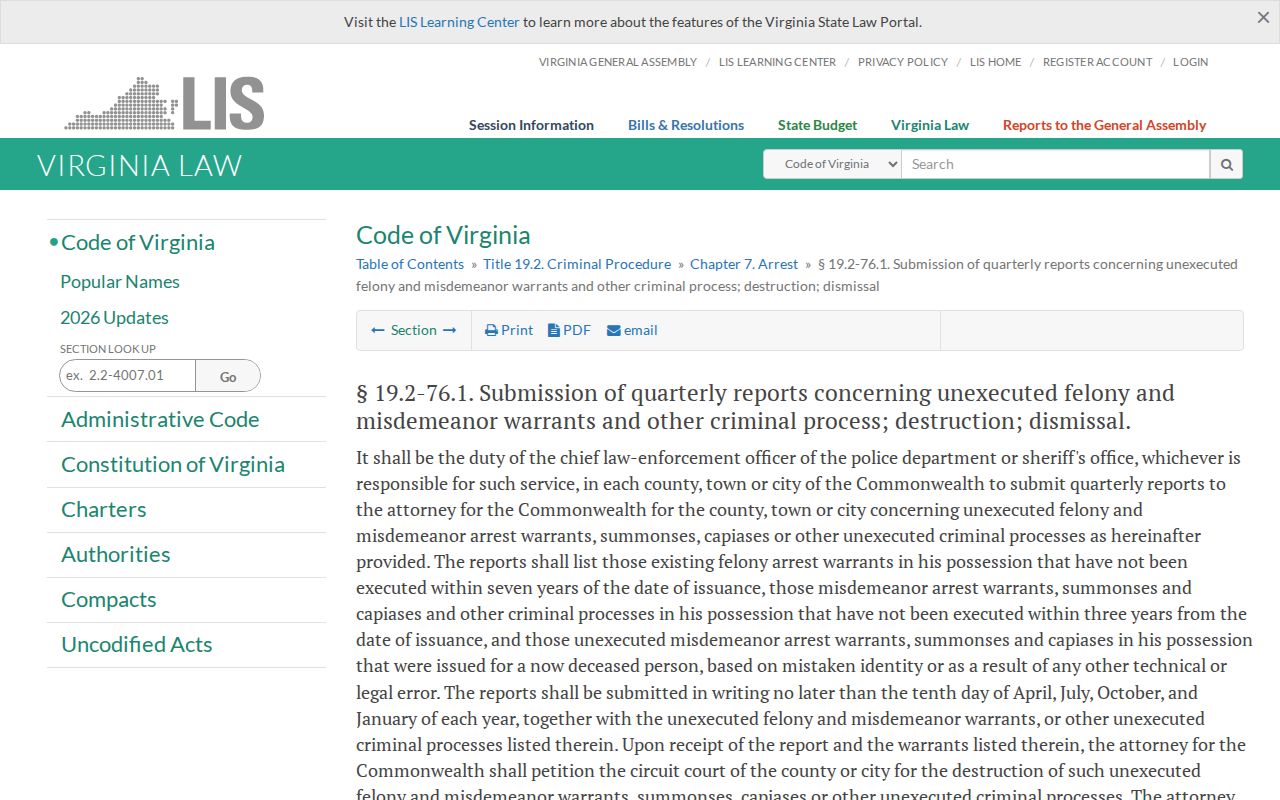
That line drawn by Virginia Code § 19.2-76.1 is why an old docket entry still needs confirmation from the Virginia court that owns the case.
Virginia Courts That Issue Bench Warrants
Virginia runs one unified trial-court structure across its counties and independent cities. Adult traffic, misdemeanor, and local-ordinance cases ordinarily begin in the locality's General District Court. Circuit Court handles felony trials and other broad-jurisdiction matters. Juvenile and Domestic Relations District Court covers juvenile, family, and support cases, with tighter public-access rules. A magistrate can issue warrants, summonses, and other process, but a magistrate is a judicial officer rather than a separate court tier. Note that Virginia has no standalone municipal court and no justice-of-the-peace system.
Whatever court owns the case controls the docket and the recall question. A sheriff or police office may hold a service copy or help arrange an appearance, but neither can substitute for the judge's order. Start with the notice and the locality, then use Browse Counties to reach the right county route. Virginia's court map and locality finder helps when an independent city sits beside a county with a similar name.
| Case context | Likely court record | Access note |
|---|---|---|
| Adult traffic or misdemeanor | Local General District Court | Clerk confirms docket and process |
| Felony trial matter | Circuit Court | Initial process may have come from a magistrate |
| Juvenile, family, or support | JDR Court | Public case details may be limited |
| Initial warrant or bail question | Magistrate service | Judicial officer, not a court tier |
Before a Virginia Court or Jail Visit
Call before you drive anywhere. Reach the issuing clerk and the agency responsible for service, and ask a few plain questions: is the process still executable, has the court set a hearing or appearance date, which entrance or office handles the matter, and what records should you bring. Ask the sheriff or police department whether it holds the warrant and how a voluntary appearance is handled. Local practices differ across Virginia. The state has no statewide surrender form and makes no promise that a person arriving at a courthouse or jail will walk past arrest.
If a capias carries court-set bail terms, Code of Virginia § 19.2-130.1 generally directs the magistrate to honor those terms unless circumstances justify more restrictive conditions. Bail remains a case-specific decision under state law. If an arrest happens on the process, a judicial officer takes up the release question. A lawyer can review the docket, advise whether to appear or request a hearing, and help explain the missed event to the court. Keep a copy of any order and receipt. Then confirm that the court and the service agency show the same disposition on their records.