
Virginia Warrant Checks
Virginia publishes no statewide public warrant register. The Online Case Information System, OCIS 2.0, can locate some adult court cases. Still, it is not a live VCIN or NCIC warrant check. Use it as the first step in a personal Virginia warrant check. Confirm the court process with the clerk next. Ask the law-enforcement office responsible for service as well. A public result can point you toward the right courthouse, yet it cannot certify that a warrant is active, recalled, served, or absent. Gather a few details before calling: the name used on the summons or court paper, the locality, a case number if you have one, and the date of the missed hearing. A date of birth helps a clerk or warrant desk separate similar names. The OCIS name search never asks for one. Those steps keep a Virginia warrant records search tied to the case that matters to you.
- Search OCIS 2.0 by name, case number, or hearing date. Choose the court level and locality that match the court paper.
- Open the case details and note the court, case number, charge, hearing, disposition, and any service information shown. OCIS data may be incomplete or late.
- Call the issuing court clerk to ask whether a capias or other process was issued, what the current docket says, and how to request a hearing or recall.
- Contact the locality's sheriff or police warrant unit to ask which agency holds service responsibility and what to do about an appearance, surrender, or bond.
- If the court or agency cannot confirm the record, request the specific public case or agency record. Use Warrant Check for the channel-by-channel search steps and the Browse Counties directory to find the locality.
Virginia's trial courts split case types between them. Circuit Court handles felony trials. General District Court takes most traffic, ordinance, and misdemeanor matters. Juvenile and Domestic Relations District Court covers juvenile, family, and support cases, with added privacy limits. A magistrate may issue process, but the magistrate is a judicial officer rather than another court tier. Note: a clear OCIS result does not prove that no warrant exists; only the issuing court and the responsible law-enforcement agency can confirm current process.
How eMagistrate Sends Virginia Warrants to VCIN/NCIC
Virginia's electronic magistrate system links the act of issuing process to restricted law-enforcement information. The Supreme Court of Virginia's eMagistrate application has run in magistrate offices statewide since June 2005. It standardizes charge text. It also moves common process and bail information to justice agencies. The tool is secure, though. It serves courts and authorized agencies. It is no public Virginia warrant search. The Virginia State Police 2023 report explains the next step. Magistrate-issued warrants and protective orders enter VCIN and NCIC automatically. The path is the eMagistrate interface. The same Virginia report lists 180,862 warrant entries in 2023, 171,864 in 2022, and 164,708 in 2021. Annual entries are all those figures count. They are not active warrants, unique people, arrests, or public search results. For the court-geography figures, the Commonwealth's locality statistics distinguish Virginia counties from independent cities. Neither source shows whether a specific Virginia capias remains executable.
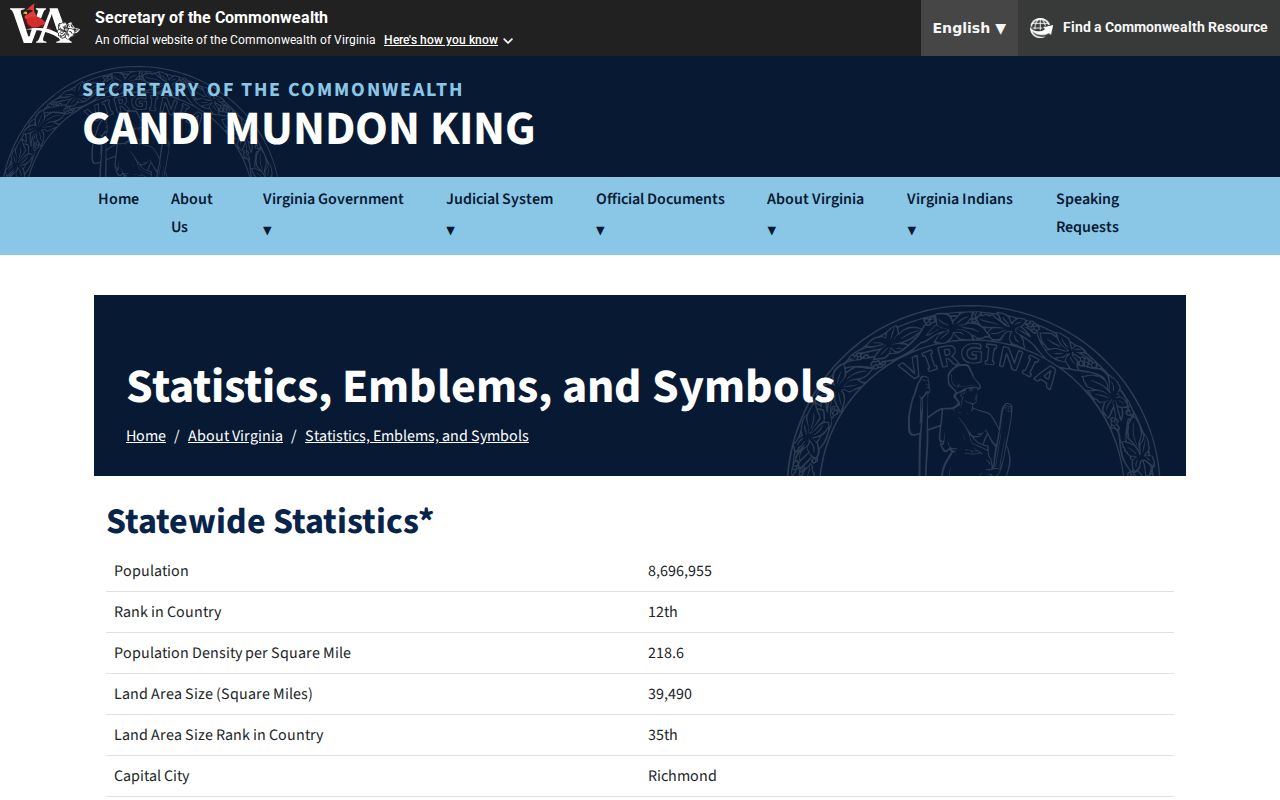
The Commonwealth's official locality statistics page draws a clear line. It separates Virginia counties from the independent cities, and both types work as court-service localities.
Virginia's Statewide Warrant System
Virginia pairs the Virginia Criminal Information Network, VCIN, with the FBI's National Crime Information Center, NCIC. The Virginia State Police administers VCIN. It also backs criminal-justice agency access to the national network. Both systems are closed. Public access stops there. No private citizen can sign in, run a warrant query, or view the law-enforcement record behind a match. Virginia's public court layer works differently. OCIS 2.0 shows case information that clerks enter. The VSP Wanted Persons page posts selected public notices with tip contacts. Neither is a full warrant index. A felony warrant can sit in VCIN and NCIC without ever appearing as a public result. Local process can also fall outside a portal's visible case categories or lag on its public docket. The two layers answer different questions. A database entry helps agencies locate and validate process. The issuing court keeps the case order. The sheriff or police agency handles execution. Read Warrant Database for a fuller account of the statewide machinery. Treat these Virginia sources differently: a public case search, a restricted law-enforcement index, and a curated notice are not interchangeable warrant results.
| System or service | What it holds | Public use |
|---|---|---|
| VCIN / NCIC | Restricted criminal-justice wanted-person and warrant information | Authorized agencies only; no public search |
| eMagistrate | Secure magistrate process creation and transmission to justice agencies | Internal court technology, not a public portal |
| OCIS 2.0 | Selected court case, hearing, and disposition information | Public case lookup; not a complete warrant-status check |
| VSP Wanted Persons | Curated public notices and tip contacts | Program page; not a full active-warrant list |
Use the Virginia court map to see how the Commonwealth lays out its courts. The page shows the Circuit, General District, and Juvenile and Domestic Relations District Court structure that supports local routing.
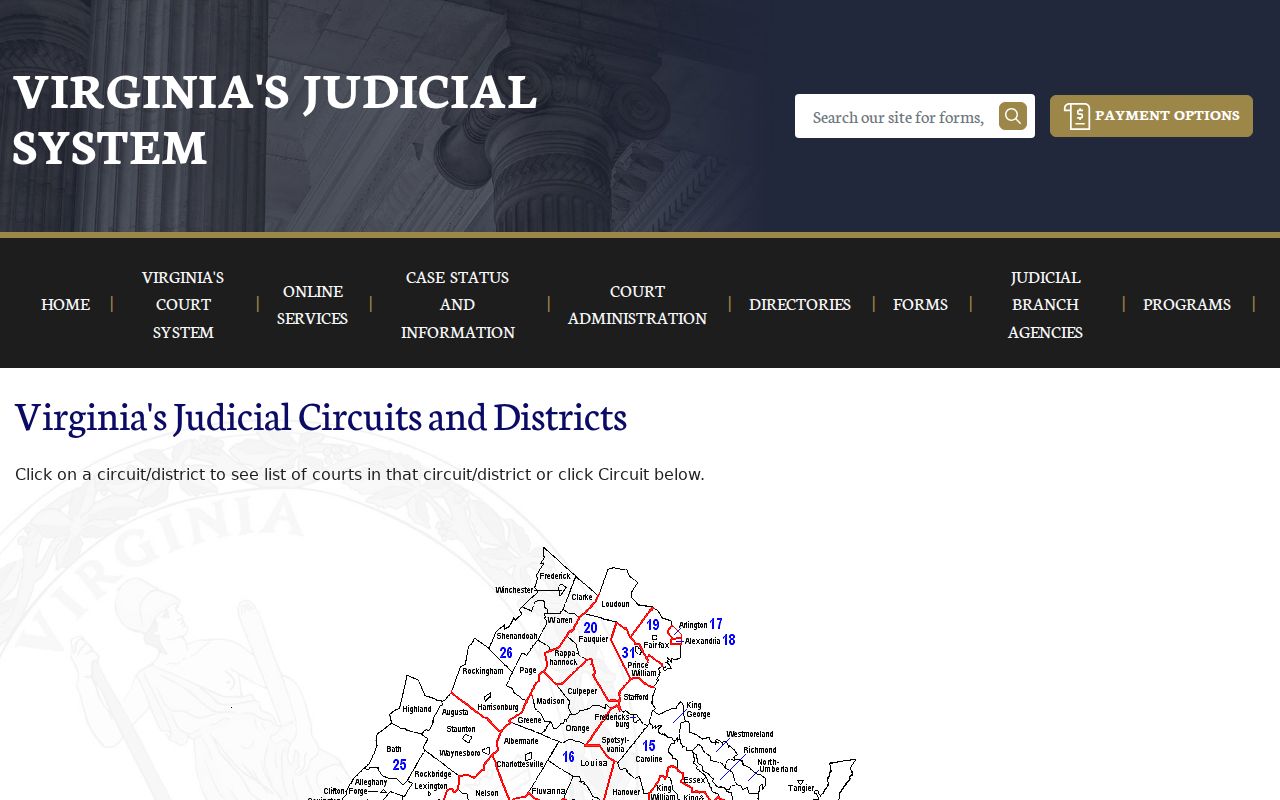
The map identifies the locality and the court tier. It does not search warrant status, and it cannot replace confirmation from the Virginia clerk and the serving agency.
Search Virginia Court Cases Through OCIS 2.0
OCIS 2.0 is the widest public court-case search Virginia offers, though the word statewide needs care. Name and hearing-date searches reach the courts Virginia makes available. A case-number search is different. It forces you to pick one specific court. The locality menu shifts by court. Some Circuit Court case information appears only where a clerk participates, so the portal's fields give you case context rather than an all-courts warrant status. When you enter a case number, copy it exactly as the Virginia court paper prints it. The official help shows formats such as GT12345678-90 for a traffic case and CR12345678-90 for a criminal case. Those are court case numbers. They are not universal warrant numbers. A result can show the court, case number, defendant, offense date, hearing date, charge, and code section, and details may include disposition and service-of-process information.
| Search control | What it accepts | Limit to remember |
|---|---|---|
| Search by name | Name as written on the summons or court paper; partial names are allowed | Each entry must contain at least two characters; there is no public DOB field |
| Search by case number | Case number with the court selected | Use the specific court; prefixes vary by case type |
| Search by hearing date | Date in MM/DD/YYYY format and available court selection | A date result is still case information, not a warrant check |
| Court level | Circuit, General District, or J&DR Court | JDR and juvenile details have access limits |
The OCIS search help pages walk you through each search mode and explain what the result fields mean. One caution from the courts: the data come from clerk entries, which can be inaccurate, incomplete, or out of date. So a blank result is not proof that no Virginia warrant exists. Only the issuing court can confirm one.
Note: OCIS terms bar data mining, so keep the portal to a focused case inquiry.
Warrants in Virginia: The Main Types
Virginia courts work with several kinds of judicial process, and the names carry weight. A probable-cause arrest warrant lets officers take someone into custody. A capias is different. It directs that a person be brought before a court after a set event. A summons orders an appearance. It carries no arrest power. A search warrant, by contrast, authorizes a defined search rather than an arrest. When a Virginia paper matters, read the document and docket to see which process applies.
| Process | How it arises | Where to confirm |
|---|---|---|
| Arrest warrant | Sworn complaint and a judicial probable-cause decision | Issuing court and responsible sheriff or police agency |
| Capias or attachment | Court process to bring a person before the court; the case posture controls | Issuing clerk and agency assigned to serve it |
| Search warrant | Judicial authorization to search a defined place or item | Issuing court; affidavit access follows a separate statute |
| Governor's warrant | Formal process for rendition to another state after requisition | Agency and court handling the extradition matter |
| Civil warrant in debt | Starts a civil money claim in General District Court | GDC civil case record; it is not an arrest warrant |
Virginia has no separate municipal or justice-of-the-peace court tier. A city traffic or ordinance case usually lands in that locality's General District Court. Juvenile, family, and support matters go to JDR. Some go to Circuit Court instead. The phrase bench warrant may sound familiar from other places, but Virginia papers often say capias, attachment, or arrest warrant. Trust the paper's own words.
Virginia Capias, Summons, and Warrant Terms
Terms in Virginia warrant records can sound alike yet do different things. Read the actual court paper. Do not translate a label from another state. Form DC-361 is titled “Capias - Attachment of the Body.” It is not every missed-date process, a civil warrant, or a generic capias pro fine label.
- Capias
- Court process directing that a person's body be brought before the court; the order and case posture define its purpose.
- Summons
- Notice requiring a person to appear, often used instead of immediate arrest process.
- Failure to appear (FTA)
- Missing a required court event; the legal result depends on notice, intent, procedure, and the judge's order.
- Recall or quash
- A court action withdrawing or setting aside process; payment alone does not prove the judge recalled it.
- Bond forfeiture
- A possible loss of security after a failure to appear, subject to notice, good cause, and court review.
- VCIN
- Virginia Criminal Information Network, a restricted justice-agency system rather than a public warrant lookup.
Other Virginia terms carry their own meanings. A warrant in detinue is a civil claim for the return of property. In older General District Court searches, archived refers to case data. It is not an active-or-cleared warrant code. Nor does Virginia use a uniform statewide warrant number pattern or status vocabulary.
Virginia Warrant Records: What They Show
A public Virginia case result is not the restricted VCIN or NCIC entry. OCIS may list the court, case number, defendant, charge, dates, hearing, disposition, and some service information. Virginia promises none of it is current. Active warrant status does not appear for every case. Juvenile data and sealed information face extra limits. Start with the court, locality, case type, and most recent event. A pending case can have no warrant. A warrant can also exist with no clear public status field. For enforcement, ask the sheriff or police unit for that locality. For the order, ask the issuing clerk. One Virginia warrant record can involve both offices, each on its own update schedule.
| Case or process number | Use the number printed on court papers. Virginia does not publish one public statewide warrant-number format. |
|---|---|
| Example case number | GT12345678-90 is an OCIS help example for a traffic case, not a universal warrant number. |
| Charge or offense | OCIS may show a charge and code section, subject to case type and access restrictions. |
| Issuing court | Circuit, General District, or J&DR Court; court tier depends on the case. |
| Hearing and disposition | Case events entered by the clerk; confirm the official docket with the court. |
| Service or status | Some service data may appear, but Virginia has no public statewide active/recalled status code. |
Note: A case status, service return, or payment receipt is not a warrant recall in Virginia unless the issuing court confirms it.
Virginia Warrant Cases: 2026 FTA Rules
Virginia's 2026 legislation clarifies how a court judges a willful failure to appear. Chapter 241 takes effect July 1, 2026. It defines willfulness as intentional conduct meant to avoid judicial process. Courts must then weigh the circumstances. The law lists examples: an unforeseen illness or injury, a transportation problem, an inability to obtain dependent care, and steps taken to communicate or correct the missed appearance. None of this makes every missed court date harmless. The law does not auto-recall a warrant or capias. The Virginia court still weighs the case, notice, history, and the order in front of it. If you missed a date, call the issuing Virginia clerk promptly. Explain what happened. Ask what motion, hearing, or appearance process applies. An attorney can review the docket and help present the facts. The enacted Virginia HB 933, Chapter 241 changes FTA and contempt rules in Virginia, not the public search system. It builds a legal framework for court decisions. It creates no statewide amnesty week or searchable warrant list.
Warrant Record Access Under Virginia Law
Public access in Virginia turns on who holds the record and what kind of information it is. The Virginia Freedom of Information Act, or VFOIA, governs requests to public bodies within statutory exclusions. A VFOIA request seeks an existing agency record. It does not open VCIN or NCIC to you. Nor must an agency build a new statewide warrant report. Virginia court records follow court-specific custody and access rules. Circuit clerks keep Circuit Court files. General District Court clerks handle most traffic and misdemeanor files. JDR matters carry added confidentiality limits. Search-warrant affidavits sit under a separate access rule. Do not apply that rule to every arrest-warrant record.
Virginia access rules:
Code § 2.2-3704 generally requires an initial VFOIA response within five working days. It does not promise immediate production or disclosure.
Code § 16.1-301 restricts juvenile law-enforcement records, subject to stated exceptions.
Code § 19.2-54 addresses search-warrant affidavits after execution or 15 days, whichever comes first, unless temporarily sealed for good cause.
Start any Virginia record request by pinning down the basics: the locality, the court, the case number if you have it, a rough date, and the record itself. The clerk of the right court is your first stop for a case file. A sheriff or police office answers for the records it holds in Virginia. For state-level requests, VSP takes public-record submissions through an online portal and its other stated channels, and it will give an estimate before any large search. Note: VFOIA charges may reflect actual search and copying costs, and statutory exclusions can limit access to investigative or confidential records.
Resolve a Virginia Warrant
Virginia offers no single online button for clearing a warrant. What you should do depends on the type of process and the court that issued it. First, identify the case and ask the clerk whether a warrant, capias, or other process is active. Then ask the sheriff or police unit handling service how to arrange a voluntary appearance or bond. Never travel to a Virginia office or jail based only on a generic search result.
- Find the locality and court from a summons, court paper, OCIS result, or attorney's file.
- Ask the clerk about the current order, any pending hearing, and how to request a reset, recall, or quash.
- Ask the responsible sheriff or police agency about service status, surrender, booking, and the local bond process.
- If arrested on process, a judicial officer decides release terms under Virginia bail law. A bond amount is case-specific, not a statewide price.
- Keep the court order and payment receipt, then ask the court and agency whether their records have both been updated.
A capias can carry court-set bail terms, and a magistrate usually follows those terms unless circumstances point the other way. If the problem is a payment default, the court may accept a revised payment plan or other relief the law allows. Neither a private bond premium nor a payment receipt proves the process was recalled. Effective July 1, 2026, Virginia HB 16, Chapter 544 requires courts to set up community-service credit programs for eligible fines and costs. A credit can knock down a qualifying balance, but the court still has to say what happens to any separate process. Ask the clerk about the court's current program and get an order showing how the case was resolved. No statewide warrant-amnesty or safe-surrender program exists, so check with the Virginia court that owns the case.
Virginia Traffic Warrants and License Holds
Virginia stopped suspending licenses solely for unpaid court fines and costs on July 1, 2019. DMV lifted those fines-only suspensions and waived the related reinstatement fees, though the court debt itself stayed due. Miss a traffic hearing, and Virginia courts can still issue process depending on the facts and any order in place. Keep the two records straight: a traffic warrant and a driver's license status are separate things, and DMV runs no public warrant lookup. Before paying an eligible General District Court ticket, read the court's warning, because prepayment in covered cases waives the hearing and enters a guilty plea. The online payment page lists a 4 percent convenience charge for card payments. A payment may settle the ticket balance, but only the issuing court can confirm whether a capias or other process was recalled. The Virginia DMV fines-and-costs guidance lays out the 2019 policy and separates it from unrelated suspension grounds, and it is not a warrant search or clearance service.
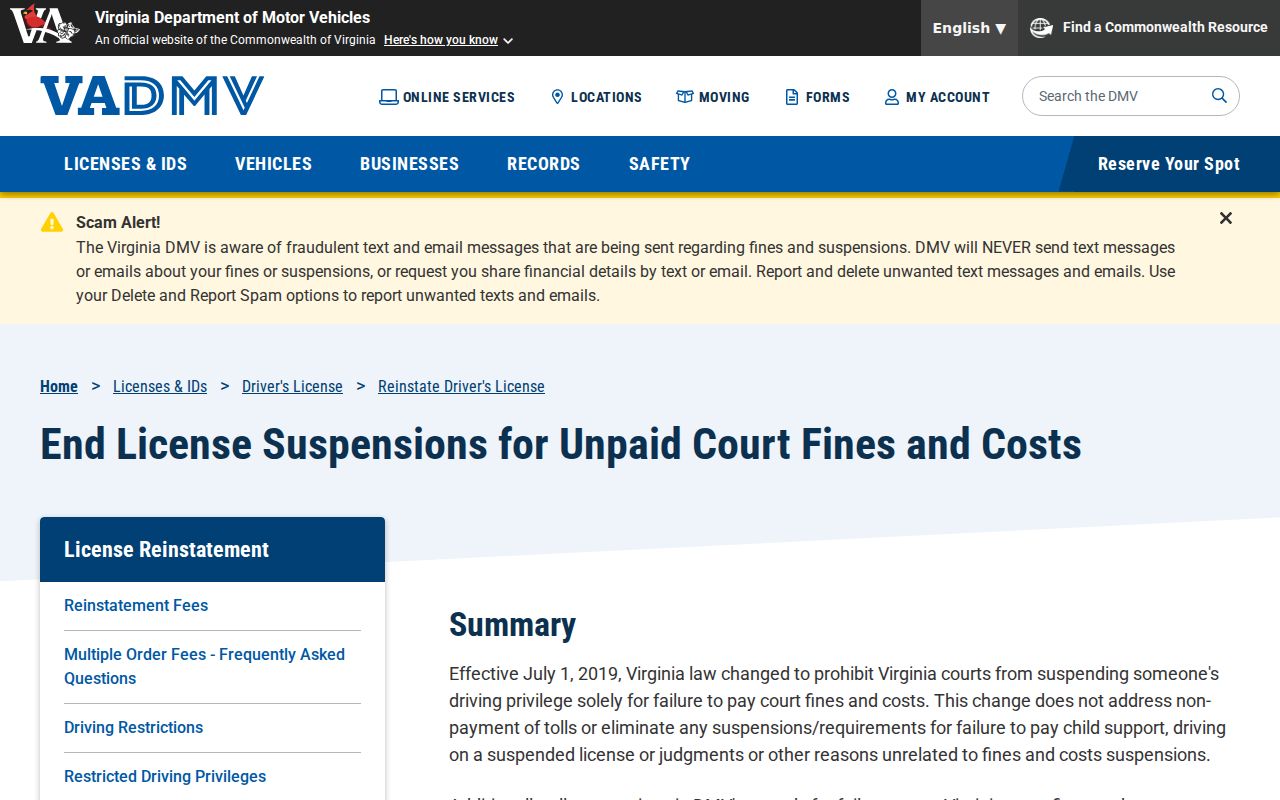
That DMV notice covers state policy only. For a Virginia traffic case, the General District Court clerk confirms the case and process. The local sheriff or police agency confirms service. DMV answers nothing but separate license-status questions.
Virginia Warrant and Fugitive Programs
Virginia State Police runs a curated Wanted Persons page with official tip contacts. Treat it as public communication, not a complete warrant register. A Virginia warrant can be active and never show up there, and the page is no way to confirm your own court status. Use it as VSP presents it, and take personal case questions to the issuing court and the agency responsible for service. Federal process works through an entirely different court system. Virginia sits in two federal districts, and the U.S. Marshals Service partners with state and local agencies on federal fugitive work. The Capital Area Regional Fugitive Task Force covers a multistate area that includes Virginia. Public federal dockets can help you find case filings, but sealed records and gaps in contributed documents mean an empty search does not prove no federal warrant exists. For a possible federal case, call counsel, the issuing federal court, or the U.S. Marshals district office. For a Virginia state or local warrant, go back to the locality clerk and the serving agency. Federal and local processes never collapse into one statewide warrant result. The official Virginia State Police Wanted Persons program posts its current public information and tip route.
Virginia Warrant Process Review
Virginia law builds in a review path for some unexecuted process that has sat outstanding for years. Under Code § 19.2-76.1, law-enforcement chiefs send quarterly reports of eligible process to the Commonwealth's Attorney, who then petitions Circuit Court for destruction. Felony process unexecuted for seven years makes the list. So does misdemeanor process and certain other papers unexecuted for three years. The court order is what matters. Aggravated-murder process and papers kept for an active investigation are among the statutory exceptions. Once a destruction order is entered, no arrest may be made under that process. Separately, Code § 19.2-390 makes the destroying agency clear the related VCIN or NCIC entries. Time alone does not erase a warrant. Ask the court and the service agency whether the process was reviewed and whether an order was entered. This Virginia rule is not a promise that every warrant expires after three or seven years. For an old case, request the official docket and ask whether a court order changed the process, because an online archive label is not a destruction order.
Warrant Records by County in Virginia
Every Virginia warrant sits in a local file. The court that issued it, its clerk, or the sheriff serving it holds the answer. Virginia splits its local records across 95 counties and 38 independent cities, and the network reaches 107 locality sites. Not every independent city has a site. Match the locality printed on the summons or court paper. A nearby county will not hold a city case. The featured routes cover several of the state's largest county populations. Those counts describe people, not warrant caseloads, and come from the 2020 Census. Each office and portal named is local in scope, and none works as a Virginia-wide warrant search.
Fairfax County
Seat: Fairfax. The sheriff's public FAQ gives a warrant-desk contact; its civil-process search is not a criminal-warrant lookup.
Prince William County
Seat: Manassas. The sheriff's FAQ distinguishes court- or sheriff-originated warrants from police-originated cases.
Loudoun County
Seat: Leesburg. The sheriff's communications center lists warrants control and VCIN/NCIC duties.
Chesterfield County
Seat: Chesterfield. The official active-warrant report warns of gaps and possible omissions.
Henrico County
Seat: Richmond. The sheriff describes process service and court security; confirm criminal-warrant routing locally.
Arlington County
Seat: Arlington. County and court locality for statewide records routing; a dedicated public warrant portal was not verified.
Stafford County
Seat: Stafford. Northern Virginia route; check the current court and service-agency contacts.
Spotsylvania County
Seat: Spotsylvania Courthouse. Fredericksburg-area route; local warrant channels should be verified directly.
Use Browse Counties to reach any of Virginia's 107 county or independent-city locality sites. Each one is a local route, not a statewide source.