
How Virginia Runs Its Most Wanted List
Virginia State Police, or VSP, runs the official Wanted Persons program for Virginia. Its page features selected notices. It lists contacts for tipsters too. The program is curated, though, and serves a tip function rather than a full public registry. It is not a searchable roster of Virginia warrants. No statewide reward schedule appears there, no fixed update cycle, and no public search form by locality or court. The notices stay on the State Police site. That split matters for a warrant check. A notice present or absent tells you nothing about a separate active warrant pending in a Virginia court. Check VSP's page for the current program details. For personal status, ask the issuing court and the local sheriff or police agency responsible for service.
Virginia State Police Wanted Persons
The official VSP landing page provides the current program notice and agency contact route. Follow the official page for its terms.
The Virginia State Police Wanted Persons page carries the program title and its general area for tip contacts.
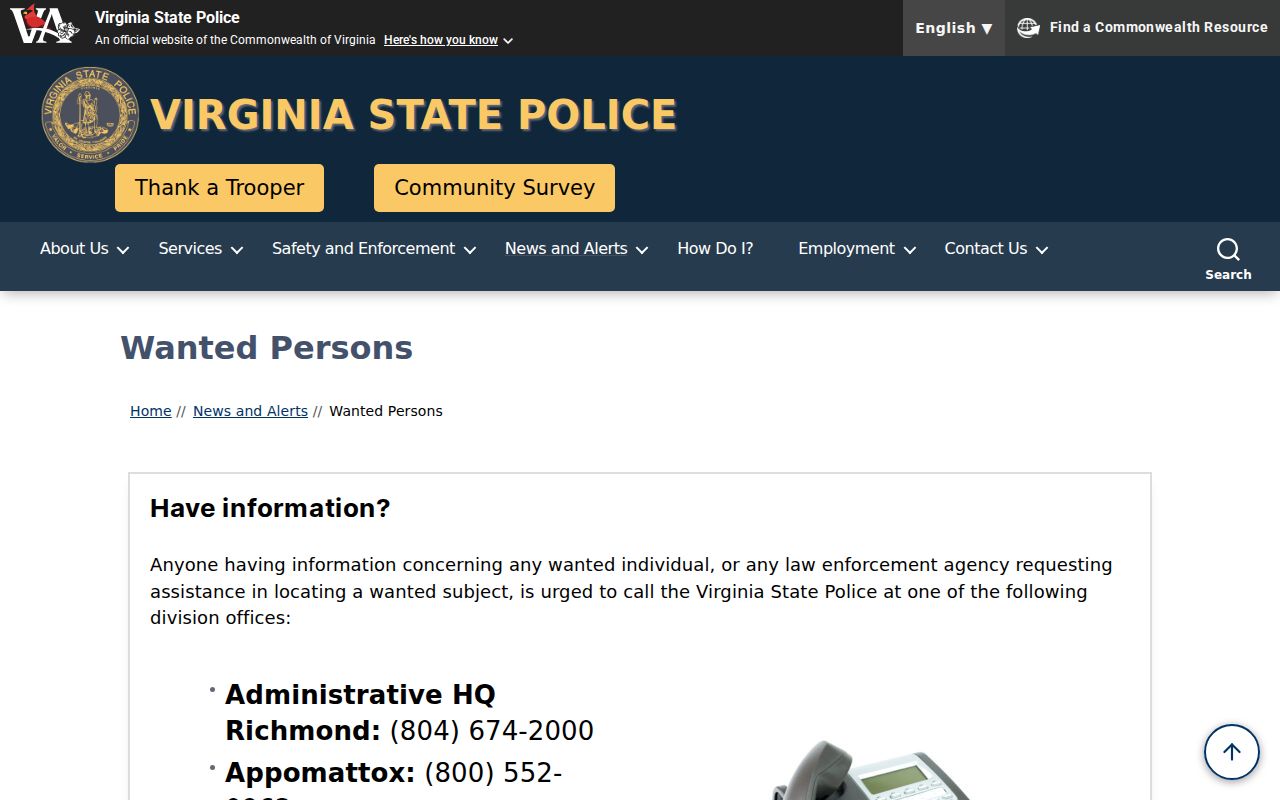
The Virginia page shows a masthead and general contact details. Person-level notices appear only on VSP's own site, never in a repost.
Virginia Wanted Notices Are Not a Warrant Search
The VSP page is a curated public program. It has no county selector. It offers no court or case search. There is no active-status filter and no downloadable statewide warrant index for Virginia. The page does not explain how notices are chosen or how often each one is refreshed. Check the current official page for those details. Do not infer anything from a missing Virginia notice. VCIN and NCIC sit behind that: restricted criminal-justice systems, not tools for a personal warrant lookup. A Virginia resident can face court process without ever appearing in a public notice. A Virginia tip notice, in turn, is no substitute for the issuing clerk's current docket or a serving agency's confirmation. For the program itself, use the VSP Wanted Persons page. Skip copied lists and image reposts as sources.
Statewide or County Most Wanted in Virginia
Virginia gets a state-level VSP Wanted Persons program. Some local sheriffs run their own wanted or active-warrant pages too. Format and contact routes vary by agency. A county page carries its own notice limits. It is not a mirror of the state program, and the comparison below covers source types, not individual notices.
| Feature | Statewide List | County List |
|---|---|---|
| Maintained By | Virginia State Police | Some local sheriff's offices |
| Purpose | Selected public notices and official tip contacts | Agency-specific local notices or active-warrant reports |
| Coverage | Curated, not a complete statewide warrant register | Limited to the local agency's stated scope and records |
| Rewards and Updates | No statewide reward schedule or update cadence was identified in the reviewed landing page | Check the local page for its terms; do not assume a shared rule |
| Where to Find It | Official VSP program page | Browse Counties for the relevant locality |
Open Browse Counties to find your Virginia county or independent city. See whether its sheriff posts wanted notices. It routes you to local agencies only.
Virginia Tip Instructions Belong on VSP
For current contact instructions tied to a Virginia Wanted Persons notice, the official landing page is the place. VSP publishes no statewide cash reward schedule. It sets no uniform anonymity procedure either. Do not assume either a benefit or a requirement; follow what the agency itself posts for its program. A contact listed there passes information to law enforcement. It cannot confirm a private person's full court status. The VSP page offers division-office contact routes, so use the one shown on the Virginia page and share information directly with the agency. Skip reposts, screenshots, and third-party summaries. They age fast. They can also point you to the wrong office entirely. If the worry is your own Virginia case or a family member's, a tip line is the wrong channel. Ask the issuing Virginia court and local agency instead. Current directions stay on the official VSP Wanted Persons program page, and instructions can change, so consult that page when making contact.
Sending a Virginia Tip Safely
VSP's Wanted Persons page is the official channel for information tied to its statewide notices. Read the current instructions first. Then send what you know through a route the agency lists. Virginia State Police publishes no statewide tip reference number, anonymity guarantee, or cash reward schedule. Rely on them only if VSP says so.
- Open the official VSP Wanted Persons page and read the current contact options.
- Use one of the agency's listed routes to pass on relevant information directly to law enforcement.
- Follow any reply or reference instructions provided by VSP; do not assume a tip has a reward or anonymous status unless the official terms confirm it.
- Do not approach, follow, or try to detain anyone. For an immediate safety emergency, contact emergency services.
Key point: Use contact details VSP currently publishes. Do not approach, follow, or publicly identify a person; share information directly with law enforcement.
Note: Reward, anonymity, and follow-up terms for Virginia tips depend on what VSP currently states on its official page.
Virginia VSP Notices and Court Records Differ
A Virginia State Police notice and a court record answer two different questions. The notice is a tip channel for the public. The court file tells you what happened in a case. The sheriff or police agency assigned to service keeps its own execution record. So no single lookup settles everything about a Virginia warrant. OCIS 2.0 displays selected court data, but it is not a full warrant-status system. VCIN and NCIC stay restricted to law enforcement. Each channel has a different keeper and a different purpose. If the matter involves you or a family member, treat the notice as background on the state program. Find the issuing locality, ask the court clerk about any warrant or capias, and ask the responsible sheriff or police department about service. A curated VSP page cannot confirm that a court recalled its process. A blank notice does not prove that no warrant exists either, and an online case row does not prove process was cleared. Ask each office only about the record it controls. Use Browse Counties to route a local question to the right Virginia locality.
Virginia Most Wanted or Active Warrant
A VSP Wanted Persons notice and an active court warrant are two different records. One is a curated public notice built for tips. The other is process issued by a court and held with the issuing locality and its serving agency. Virginia offers no single statewide active-warrant search across its public materials. The VSP page does not claim to list every current warrant either. A court can hold an active arrest warrant or capias with no matching notice at all. For a search through the public court system, turn to the Active Warrant Search page, which explains how OCIS and local records differ from a curated wanted notice and how to confirm details with a clerk or local service agency. Then open Browse Counties to find the court locality for a particular Virginia case.
Virginia Has No Statewide Warrant Roundup
Virginia runs no statewide warrant roundup. Its court system, State Police, DMV, and legislature publish no amnesty week, safe-surrender event, or statewide fee waiver. A local court may post its own payment or docket notice, but that is a local program, and the issuing court has to confirm it. The lack of a statewide campaign does not touch the court's authority over a case. VSP's Wanted Persons program is not a roundup or clearance event either. It offers selected public notices and contact details. Appearing on that page, or dropping off it, changes nothing about a warrant's court status. Resolving a Virginia warrant takes a court action suited to the case, followed by confirmation with the local agency that tracks service. For any specific matter, ask an attorney and the issuing court about a lawful appearance, a recall request, bond terms, or another case path. Campaign language never substitutes for those local instructions. Note: No statewide notice can show that the issuing court recalled a local capias or arrest warrant.
Finding Your Own Name on a Virginia List
A name on a Virginia State Police notice is worth checking, not panicking over. Skip the social media copies and read the official listing itself. Then talk to a lawyer before you act. An attorney can sort out whether the notice ties to a Virginia court case, a federal case, or a court in another jurisdiction, and can reach the right clerk or agency to work out a safe way to appear.
If the case is in Virginia, pull the court paper or the public case information and find which locality issued the warrant. From there, call the clerk. Ask whether an active warrant or capias still stands, what order controls it, and whether you must file a motion or show up for a hearing. The sheriff or police agency charged with service can explain how it confirms a warrant and handles a voluntary appearance. Keep one limit in mind: a public VSP notice is not the court file, and it cannot tell you whether a bench warrant has already been recalled.
Important: Consult a lawyer and confirm the issuing court and responsible agency before you act; a public notice cannot tell you the full status of a case.
Virginia Warrant Follow-Up Routes to Local Courts
Virginia has 95 counties and 38 independent cities, which makes 133 localities for court routing. There is no separate municipal-court tier. A city traffic or criminal matter generally lands in that locality's General District Court. Circuit Court hears felony trials. JDR courts handle juvenile and family matters with added privacy limits. Magistrates issue warrants and handle initial bail functions, but they are judicial officers inside the state system, not another local court level. The court level decides which clerk can explain the public docket and which judge can act on the process. The local sheriff or police unit can confirm its own service assignment. Use Browse Counties to reach the county or independent city that holds the case route you need. A statewide public notice cannot identify the right clerk or say whether local process is still executable. For a family member's matter, keep the question on the case and the correct custodian. A court record, a law-enforcement entry, and a State Police notice are related but separate records. Ask each Virginia office only for the status it maintains, then follow the court's instructions on the next lawful step. Note: County and independent-city courts share Virginia's state court structure, but each locality has its own case custodian and service agency.