
How Municipal Warrants Work in Virginia
Locals may say "municipal warrant," but Virginia has no municipal court tier. The label describes the city, not a separate Virginia system. Adult traffic tickets, misdemeanors, and local-ordinance violations land in that locality's General District Court. Felony trials move up to Circuit Court. Juvenile, family, and support matters sit in Juvenile and Domestic Relations District Court. A citation from a Virginia city still runs through the state courts, not a private or city-only structure. A city court warrant can also mean several different papers. It might be a new arrest warrant built on probable cause. It could be a capias or other process after a missed court date. It might simply be an order tied to an existing case. The instrument itself and the docket tell you which. A local police department may open the case while the sheriff serves the papers, or the split may run another way. Your first task is simple. Find which court owns the case and which agency serves that process.
Virginia Has No Municipal Court Tier
Virginia's city and county courts sit inside one statewide trial-court structure. Every city and county has its own General District Court. That court takes traffic violations, misdemeanors, and local ordinance cases, and it holds the related case record. Circuit Court handles felony trials and appeals. JDR court covers juvenile, family, and support matters. A magistrate can review complaints, issue warrants and summonses, and set initial bail, but a magistrate is a judicial officer, not a municipal or justice-of-the-peace court in Virginia. Calling something a "municipal warrant" is fine when you mean it happened in a city. Just don't let the phrase send you hunting for a court tier that does not exist. Read the locality on the citation or notice first. Then identify the correct General District Court or other trial court. Remember that a Virginia city and its surrounding county are separate court localities, even when they share a name or regional court services.
- General District Court
- The local trial court for adult traffic, misdemeanor, and ordinance matters in both cities and counties.
- Magistrate
- A judicial officer who performs functions such as probable-cause review, warrant issuance, and initial bail decisions.
- Independent city
- A Virginia locality separate from any county, with its own court and records route.
Municipal vs County Warrants in Virginia
The distinction that matters is the locality, not a special kind of municipal trial court. An adult traffic or misdemeanor case in a Virginia city uses that locality's General District Court, just as the same case in a county would. A city case is still not a county case. The clerk, the law-enforcement agency, and the docket all belong to the city. Confirm the locality printed on your paperwork before running a county search or calling an office. Court records and service records may also live with different offices. The clerk can trace the court's process and hearing history. The police or sheriff unit responsible can explain execution and local appearance steps. That same split exists in Virginia's county localities. A generic county list or statewide case search is never a complete warrant file. A missed appearance in a city or county case can produce court-ordered process or a new probable-cause arrest warrant, and the distinction stays the same either way. See Bench Warrant Lookup for Virginia capias and FTA terminology.
| Feature | City locality | County locality |
|---|---|---|
| Adult traffic or misdemeanor court | General District Court serving that city | General District Court serving that county |
| Locality status | Independent locality, separate from every county | County locality, with its own court records |
| Case record | City court clerk and local docket | County court clerk and local docket |
| Warrant service | Police or sheriff, depending on the process | Sheriff or police, depending on the process |
| Public online search | OCIS or a locality court search may help locate the case | OCIS or a locality court search may help locate the case |
Virginia Cities Are Separate Court Localities
Virginia counts 95 counties and 38 independent cities, which makes 133 localities, all served by one state trial-court system. An independent city is not inside a county, even when its name matches the county around it. That geography matters for a warrant search. The city clerk, the city General District Court, and local police or sheriff may hold records apart from the nearby county offices. Virginia's judiciary locality and court maps point you to the right court. A statewide name query may surface a covered case. Pick only the adjacent county, though, and you can miss the city court record. Start from the citation, case number, or hearing notice. If those papers are gone, open the official Virginia court map and call the court clerk to confirm jurisdiction.
Virginia Municipal Warrant Checks
Virginia has no single statewide warrant lookup. The closest public tool is the OCIS 2.0 case search. Use the OCIS 2.0 public case search to find a covered Virginia court case by name, case number, or hearing date. It locates cases, not warrant status. A clean result is still not a certificate of any active warrant. Warrant status lives in VCIN and NCIC systems, which the public cannot query, so only the issuing court can confirm it. Match the city or county printed on your ticket or court paper to the right court. For an adult traffic or misdemeanor case in a Virginia city, that means the city's General District Court, not a separate municipal court. City matters fold into that one state court tier. The local GDC search can make you select one court at a time, which is slow but workable. The General District Court search help page documents the controls you will meet. It covers the locality selector plus the name, case-number, and hearing-date options, all search fields rather than a person's case. Those fields make a case-search tool, not a warrant-status certificate. The newer statewide portal reaches more covered Virginia cases, while the court clerk keeps the official file and any process order.
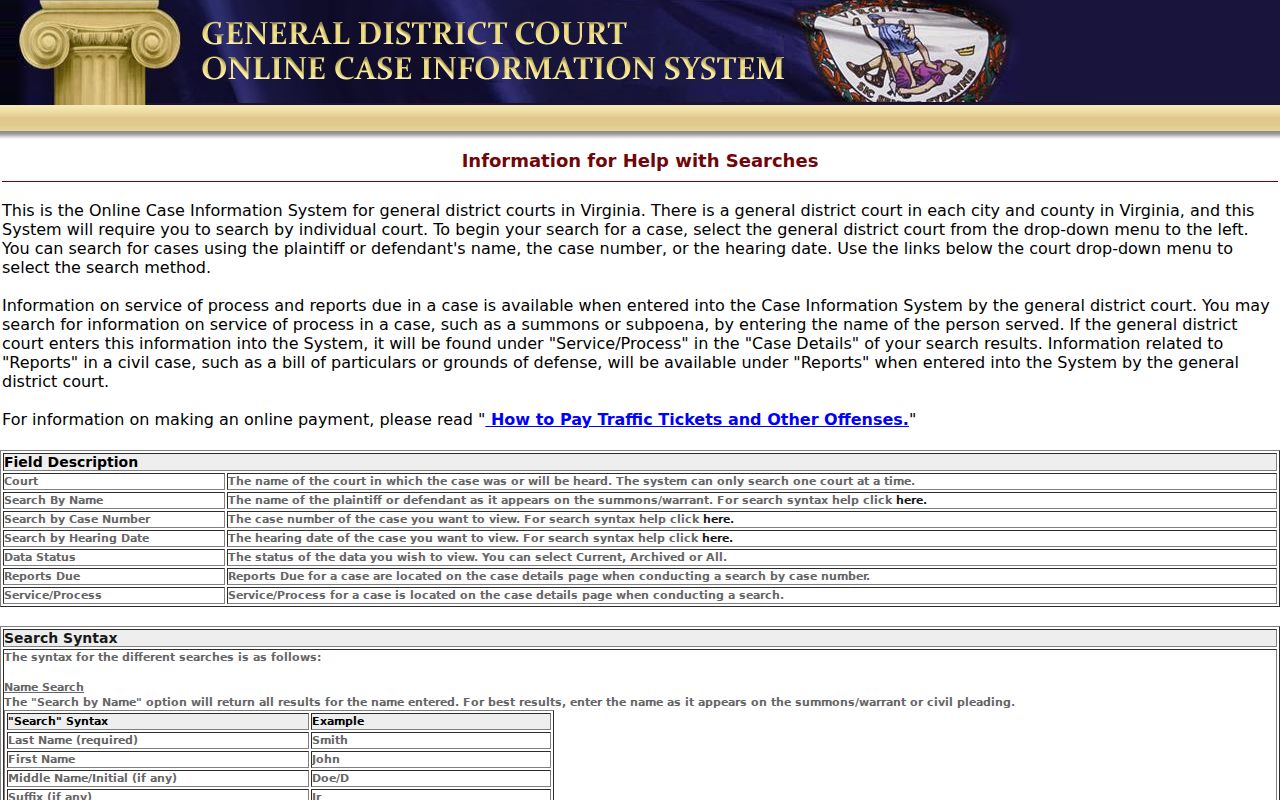
A hit from the General District Court search tells you which clerk to call. It does not settle whether local law enforcement still holds an executable warrant. That answer comes from the agency serving the Virginia warrant. When the online result is missing, ask the clerk for the public court record that exists. A records request under the Virginia Freedom of Information Act must describe the record sought. Exemptions still cover juvenile, investigative, and restricted law-enforcement material. VSP takes requests for records it holds through its FOIA page. Its Wanted Persons program is a selected tip channel, not a personal warrant check. The public cannot query VCIN or NCIC.
- Search OCIS 2.0 by the name as it appears on the paper, case number, or hearing date; use the correct city locality and court level.
- Open the case details and note the court, case number, charge, hearing, disposition, and any service information shown.
- Call the city General District Court clerk to ask which process or order appears in the official record.
- Contact the responsible local police or sheriff's warrant unit to confirm service status and ask how to arrange an appearance or bond.
- Use Browse Counties for the county route and consult the court map for an independent city not listed with a county.
Virginia City Warrants: eMagistrate History
Virginia's magistrate system is statewide even though the case and the serving agency are local. The Office of the Executive Secretary's 2007 report documents how eMagistrate rolled out. By June 2005, every magistrate office had used it. The report covers internal court technology. It is not a public warrant interface. eMagistrate standardized common charge text across Virginia. It gave authorized users real-time information access and transmitted criminal process and bail information to justice agencies. That history explains how a city warrant enters a shared law-enforcement workflow. No public city-warrant portal came out of it. The application serves judicial officers and criminal-justice users only. It is not a separate city court, a public website, or a status code for residents. You still need the clerk's docket and confirmation from local police or sheriff. In a Virginia city, confirm both the court and the executing agency, because the office that first handled the complaint may not be the one that serves the process.
Municipal Warrants: What They Show
Virginia has no municipal-court tier. That is why no standardized municipal-warrant record exists. Public OCIS results for covered Virginia cases can show the court, case number, defendant, offense date, hearing date, charge, and code section. Case details may add hearing, disposition, or limited service-of-process information. JDR cases expose less. Some complainant and service fields drop out entirely. And a warrant held in a restricted law-enforcement system will not appear as a complete public record. For the paper side, the official district-court criminal-forms manual gives a field schema for DC-361, a “Capias – Attachment of the Body.” It describes fields such as jurisdiction, court type, statutory reason, and the original sentence or fine where relevant. Those fields do not define every arrest warrant or every city case. Rely on the actual court document. Ask the clerk about anything missing or unclear, since Virginia docket entries follow no single template.
| Case reference | Use the exact identifier printed on the citation or court paper, such as the case number on the notice. No universal city-warrant number pattern is documented. |
|---|---|
| Locality and court | The city or county and the General District, Circuit, or JDR Court that owns the case. |
| Charge and code | The alleged offense and code or ordinance citation recorded by the court. |
| Issue and hearing dates | The date process or the next appearance was entered; ask the clerk whether a later order changed it. |
| Service or return | Service information may appear in court details, but the local police or sheriff may keep a separate execution record. |
| Bond or balance | Case-specific release terms or a court balance. A balance is not itself proof of an active arrest warrant. |
Virginia City Warrants After a Missed Date
A missed court date in a Virginia city is still governed by the state's law, not a municipal code. Under Code of Virginia § 19.2-128, willful failure to appear means intentional conduct to avoid judicial process. The court must weigh the mitigating circumstances the statute names. Start with the summons. Find the locality and court printed there, since Virginia folds city cases into its state court tiers. Check the Virginia case in OCIS 2.0. A missing result does not prove the absence of process. Call the General District Court clerk next. Ask whether the matter is still pending, whether a capias or other process was entered, how to request a hearing or recall, and whether a payment option would affect the case. If the notice points to Circuit or JDR Court, contact that clerk instead. Then ask the city police or sheriff about service. The clerk answers what is in the docket. The law-enforcement office answers whether it holds the process and what local appearance or intake procedure applies. A citation can start with one agency and be served by another. Never assume a Virginia city has a marshal or a dedicated municipal-court counter. Keep your search inside the locality directory. The relevant Virginia court and serving agency stay local, so a neighboring county's page will not fit.
Clearing a Municipal Warrant in Virginia
Only the court that issued a Virginia municipal warrant can recall it, quash it, or set a new court date. Police and sheriff units serve that process. They cannot undo it. Before you appear anywhere, call the clerk of the issuing court and ask how a recall works there. Ask which motion or hearing route the court uses, whether payment is accepted, and whether paying could waive a hearing or enter a plea in an eligible traffic case. Clerks handle these questions all the time. A clerk can also pull up your case-specific balance or talk through a payment plan. Keep in mind that Virginia sets no standard municipal-warrant form and no fixed bond amount, so the answer depends on the court and the case.
- Confirm the exact court, case number, and process label with the clerk.
- Ask whether the court requires an appearance, motion, new date, or payment-plan request.
- Ask the local service agency how voluntary appearance, bond, or intake is handled before traveling.
- After the court acts, obtain its order and confirm the service agency has updated its record.
Caution: Do not treat a paid balance or a blank public search as proof that court process was recalled. Confirm the order with the clerk and the serving agency.
Virginia City Warrants: Payment and Recall
Don't confuse two different records. A city traffic balance is one thing. An active arrest warrant is another. Virginia stopped suspending driver's licenses solely for unpaid court fines and costs on July 1, 2019. That change did not erase the court debt, and it did not dismiss a case or recall a capias. The Virginia DMV's fines-and-costs information explains the licensing side only. It is not a warrant lookup, and it cannot change a judge's order.
Paying a balance may satisfy a judgment or make a case eligible for online handling. The clerk should tell you whether that clears the underlying matter or whether separate process still stands. In eligible traffic cases, prepayment can waive the hearing and enter a guilty plea. Read the court's current instructions first. For a post-conviction balance you cannot pay, ask about ability-to-pay options under Code of Virginia § 19.2-358. Afterward, confirm with the judge or clerk that the outcome was recorded and that local police or sheriff records now reflect it. That last step catches stale data before it causes a problem.